AI and Product Design
When artificial intelligence is incorporated into the design process, it does not replace the designer — it reinvents the way we think, prototype and deliver.
How is generative AI fundamentally transforming product design practices? Murielle Couden, UX-UI Director at Coexya, shares her expert insight into this development and the challenges it poses for product teams.
What Is AI in Product Design?
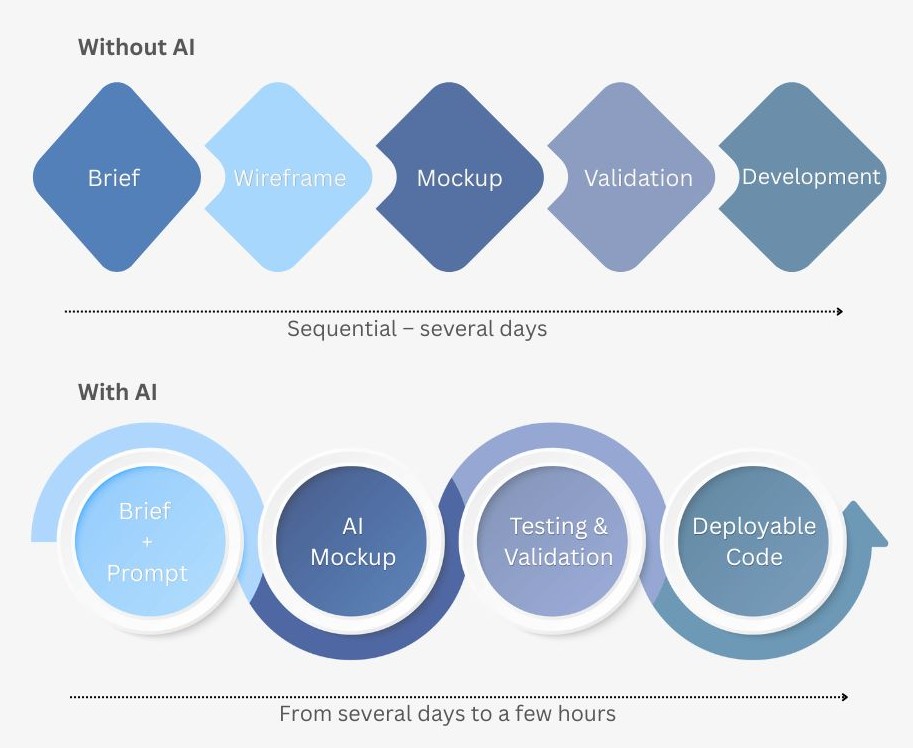
Artificial intelligence applied to product design refers to the ability of algorithmic tools to generate, suggest, or adapt digital interfaces from natural language descriptions. This is known as generative AI: solutions such as v0, Figma Make, or Lovable can now produce interactive mock-ups, components, or complete user journeys within minutes — where it once took several days of work.
This evolution does not only concern designers. It is redefining the role of every stakeholder involved in a project — project managers, developers, and product managers — by giving them access to usable visual representations much earlier in the process.
How Does AI Concretely Accelerate Product Design?
AI acts as an accelerator on several levels simultaneously.
For designers, it frees up time previously spent on repetitive tasks — resizing, responsive variations, component documentation — allowing them to focus on what truly creates value: interface strategy, user experience consistency, and design decision-making. It also opens up new creative directions by suggesting unexpected layouts or stylistic approaches.
For technical teams, the convergence is just as significant. AI-assisted prototypes rely on standardised libraries (React, Tailwind CSS, shadcn/ui, etc.), considerably reducing ambiguities between mock-ups and implementation. The transition from concept to deployable code becomes much faster.
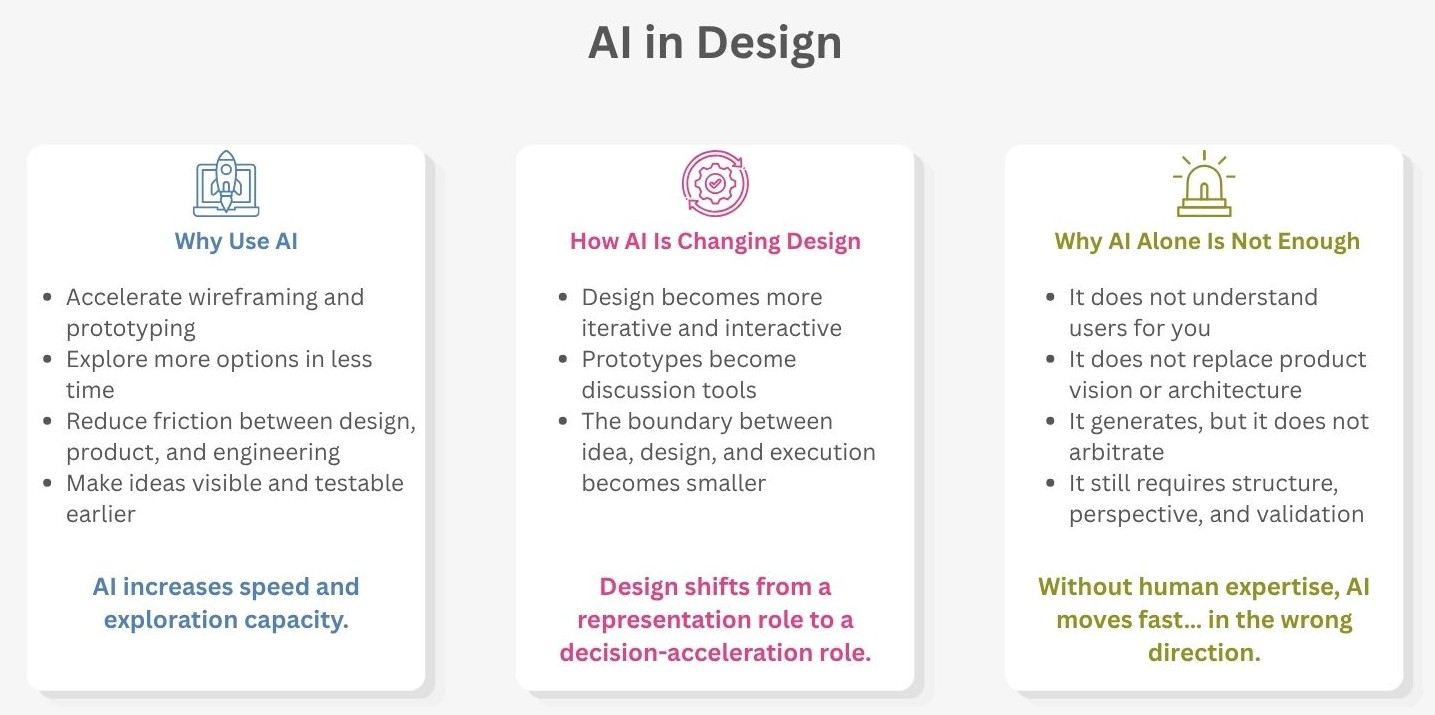
For the project as a whole, cycles become shorter. From prompt to interface, from idea to testable prototype, the boundary between design and execution is narrowing. What we observe in practice is that this ability to make an idea visible and testable from the earliest stages profoundly improves the quality of upstream decisions — while reducing misunderstandings between business, design, and technical teams.
What Are the Practical Use Cases for Product Teams?
AI in product design can be applied across a wide variety of contexts:
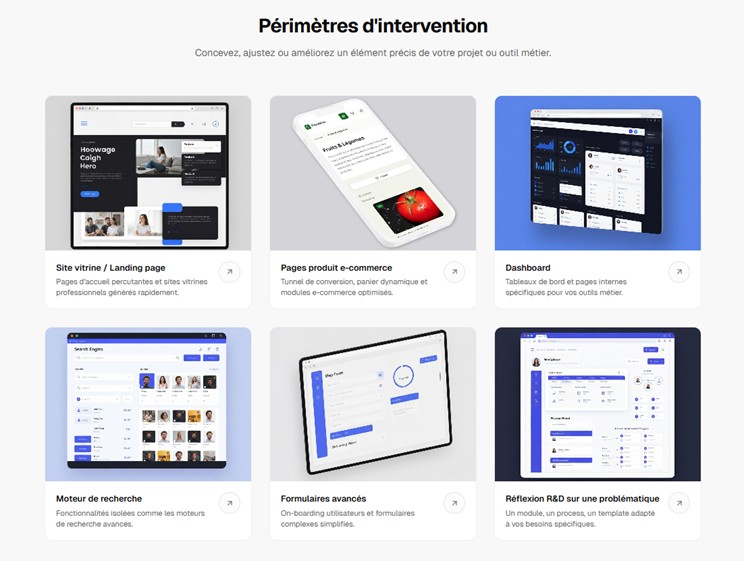
- Corporate websites and landing pages: rapid generation of impactful interfaces from a textual brief
- Dashboards and business tools: designing dashboards to visualise and manage operations
- E-commerce: modelling conversion funnels and optimised product pages
- Forms and onboarding: simplifying complex user journeys
- Proofs of concept and pre-sales: at our clients’ organisations, phases that once required several days can now deliver convincing visual demonstrations within a few hours
- R&D and exploration: testing concepts and product directions at low cost before investing in development
What Are the Limitations of AI in Product Design?
Adopting AI in design should not be done without discernment.
AI can produce generic interfaces disconnected from the existing design system, or generate components that do not exist within the project’s technical reality. It may also create unrealistic interactions or UX inconsistencies that are difficult to detect without expert oversight. The quality of the output strongly depends on the precision of the prompt: expressing a need in a contextualised way is a skill in itself that teams must learn to master.
On projects with deep functional complexity — multi-screen journeys, advanced business rules, complex modular architectures — AI quickly reaches its limits. It generates, but it does not arbitrate. It suggests, but it does not understand users on your behalf.
Two additional aspects also deserve attention: data confidentiality, as some tools transmit entered information to external models, and environmental impact — generative AI models are energy-intensive, which should be considered within any responsible digital strategy.
What AI Truly Changes for Product Teams
What fundamentally changes is the role of the designer and the project manager within the value chain. It is no longer simply about producing visual deliverables, but about leading a rapid exploration process, guiding relevant directions, and ensuring consistency between product vision, user experience, and technical feasibility.
Design becomes more iterative and more interactive. Prototypes are no longer simple representations — they become shared decision-making tools between business, design, and technical teams. And the boundary between idea, design, and execution continues to shrink as the tools evolve.
What we have learned through supporting our clients is that integrating these tools into daily practice is not about automating design. It is about freeing teams from the friction that slows down what matters most: understanding accurately, deciding quickly, and delivering experiences that truly make sense for end users. Without human expertise to frame and guide it, AI moves fast — but not necessarily in the right direction.
About the expert
Murielle Couden is a Project Manager at Coexya, specialising in digital projects and content management platforms. With over 15 years’ experience, she supports clients in the design and deployment of high-performance digital solutions. An expert in CMS technologies, particularly Ibexa, she manages complex projects with a particular focus on quality and user experience.