
Roll out search solutions to aggregate enterprise data
Deploy a search solution to aggregate data from diverse sources, provide a single point of access to information, and ensure optimal performance.
Drawing on our expertise, we support the creation of bespoke search engines that combine performance, relevance and intelligence. With over 10 years’ experience in this field, we support major clients and public institutions — TotalEnergies, Groupama, the Council of State, Unicancer, and the Centre Pompidou — using market-leading technologies: Sinequa, Elasticsearch, Algolia and Google Cloud Search.
How to connect different data sources through the internal search engine?
Information search and management is more essential than ever and has been driving companies for more than 10 years to implement search engines to match structured and unstructured information

Data search engines to simplify access and management of data
Coexya implements various search engine solutions, according to the needs and technical environments of its clients, to aggregate data from heterogeneous sources, whether structured or unstructured, and to transform data clusters into unified searchable knowledge bases.
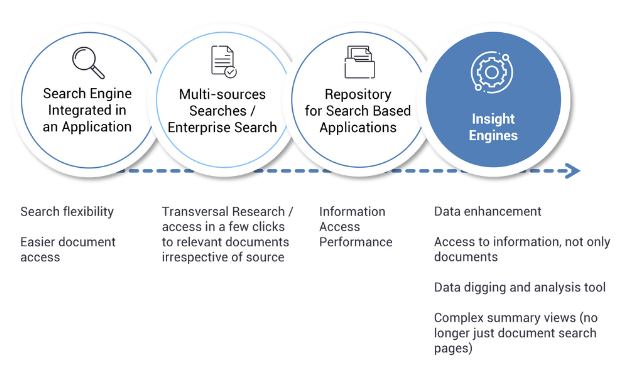
Coexya is an expert in search engine development and implementation
We are able to implement web search engine projects such as enterprise search engines or cognitive search engines with advanced processing of structured and unstructured information via Automatic Natural Language Processing and Machine Learning components.
Cognitive Search integrates the power of artificial intelligence
We have supported the technological evolution of these tools, which have now largely overcome the simple use of document search, to respond to advanced use cases: synthetic views such as 360° vision, technical and competitive intelligence, expert search, dashboards on structured and textual data, etc.
We implement search tools to facilitate quick access to relevant information by providing a single point of access to documents from multiple sources.
- Identify similar documents (close, versions, duplicates)
- Link content to promote bouncing between related documents
- Synthesize information through business-oriented views that summarize the main information and allow for drill down according to the user’s needs and profile
We integrate the latest technology in language data processing: NLP, Machine Learning
The data indexing chain now integrates advanced text analysis components (Natural Language Processing), content classification (machine learning models), and similar document detection, bringing these platforms to a new level of intelligence to extract useful information from raw text.
Gartner’s presentation of search platforms as Insight Engines captures the technological evolution from document search to recommending useful information to the user.
We propose our advice and our technical knowledge to the development of your enterprise search engine solutions
Our sector knowledge and our project experience allow us to operate as a consulting integrator, advising our clients on the key success factors for the deployment of a search engine, regardless of the technologies used.
Discover ConSore, the medical search engine dedicated to cancer
Discover Consore
This video showcases a demonstration of Consore, a powerful search tool for creating patient cohorts.
This tool leverages data from Cancer Centres, enabling the formation of patient cohorts within a single establishment, as well as performing counts on a national scale by querying other Cancer Centres.
Its strength lies in its ability to process multi-format data (both structured and unstructured), allowing for searches based on multifactorial criteria.
White Paper - Evaluation of a RAG solution
In this white paper, Coexya’s experts decipher the issues involved in implementing and optimising a RAG (Retrieval-Augmented Generation) solution. Through concrete methodologies, use cases and automated evaluation tools, this document guides you step by step through the implementation of a reliable framework for testing, adjusting and upgrading your document search augmented AI systems.
Download the white paperNos partenaires

Sinequa offers the key features of an enterprise search platform: a large catalog of connectors to interface with over 150 types of data sources, a comprehensive web administration interface, an extensible user interface template, natural language processing components and machine learning.
See more
Algolia is a search solution and a complete suite of APIs in a SaaS model that allows teams to easily develop fast and personalized search experiences that meet user and business expectations.
See more
At the center of the Elastic suite, this powerful and scalable search engine allows to address various use cases, from indexing and searching application logs (key use of the ELK suite), to documentary search or to searches combining structured criteria and full text search.
See more
The Cloud Search solution allows you to search across an organization's entire data set, while taking advantage of Google Cloud's reliable, high-performance infrastructure.
See more
Mindbreeze is a leading global provider of AI-based knowledge management solutions. Mindbreeze InSpire redefines how organizations access and utilize information. Powered by advanced AI, it transforms complex data into actionable insights, seamlessly connecting and analyzing information across systems.
See more
Squirro is a global leader in enterprise-grade generative AI and knowledge graph solutions, specializing in semantic search, insights, and automation. Since its founding in 2012, the company has been at the forefront of AI innovation, empowering organizations with intelligent technology that enhances decision-making and efficiency.
See moreOur references

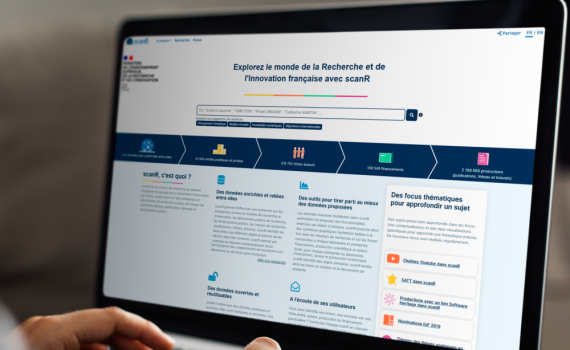







Related news

Search & Insight Engine Expertise: Why choose Coexya?
- Semantic Search & AI (NLP): We integrate natural language processing (NLP) technologies to transform your text searches into powerful decision-making tools.
- Unified Access to Knowledge: Deployment of Enterprise Search solutions capable of indexing and cross-referencing your data from diverse sources (EDM, ERP, Cloud, websites) within a single access point.
- Performance & Relevance of Results: Fine-tuning of leading search engines (Elasticsearch, Solr, Sinequa) to ensure fast, secure results that are perfectly tailored to each user’s profile.
FAQ: Maximising Data Access with Powerful Search Solutions
-
/ What is the difference between classic search and AI-powered semantic search?
Classic search relies on strict keyword matching, which often produces irrelevant results. Semantic search, enhanced by artificial intelligence, understands the user’s intent and context — handling synonyms, typos and related concepts. At Coexya, this approach is central to the search engines we deploy for clients such as TotalEnergies, Groupama and the Conseil d’État: users reach the most relevant information from their very first query.
-
/ What is RAG (Retrieval-Augmented Generation) and how can it benefit my organisation?
RAG is an architecture that connects a generative AI to your own secured data sources. Unlike a standard AI that can hallucinate or return outdated information, RAG constrains the AI to draw its answers exclusively from your internal documents — knowledge bases, reports, procedures. Coexya offers RAG Factory, a turnkey solution for testing and industrialising this technology on your data, within an ISO 27001-certified environment.
-
/ What is the difference between a classic search engine and RAG?
A classic search engine returns a list of links. RAG analyses the most relevant documents to produce an accurate, sourced answer to your question, leveraging the power of large language models on your own data. Coexya’s Search & AI teams support this transition from document retrieval to generative assistant, drawing on over 10 years of experience in the field.
-
/ How can we ensure the search engine respects access rights?
Security is at the heart of Coexya’s approach. Our solutions — such as Sinequa or Elasticsearch — inherit rights directly from your source systems (Active Directory, etc.). A user will never be able to retrieve a document they are not explicitly authorised to access.
-
/ Can non-textual data be indexed?
Yes. Through the AI components integrated into the solutions deployed by Coexya, it is possible to index images via OCR, scanned handwritten documents or complex technical files, making them searchable by keyword or semantic concept. This is, for example, what Coexya implemented for Unicancer, with multi-format processing of medical data.
-
/ How do you measure the return on investment (ROI) of such a project?
ROI is measured along three axes: operational time savings (reduced time spent searching for information), error reduction (ensuring the latest version of a document is always used), and the increased value of the organisation’s intangible knowledge assets. Coexya supports its clients in defining these indicators from the scoping phase, using a methodology refined over more than 10 years of Search projects.
-
/ Why choose a Search solutions expert in Paris, Lyon, Rennes, Lille, Brest…?
Implementing a search engine requires an in-depth technical audit of your data sources. Coexya, with offices in Paris, Lyon, Rennes, Lille and Brest, runs scoping workshops directly on your premises. This proximity makes it easier to fine-tune relevance algorithms to your specific business vocabulary and ensures responsive support throughout the evolution of your platform.
