IAgents by Coexya, Putting AI agents into production, sustainably
Customised and secure AI agent solutions for businesses
Today, the real challenge is no longer creating an AI agent. The challenge is to make it work reliably over time: supervising it, managing risks, measuring its value and truly integrating it into the existing information system. IAgents supports organisations after the POC, when the first operational questions arise: reliability, responsibility, operation and real value.
Why do most AI agents stall after the POC?
Creating an AI agent is relatively simple.
Making it sustainable over time is much more complex.
In practice, organisations often encounter the same situations:
- isolated POCs, with no clear owner,
- assumed but never measured value,
- agents that deteriorate over time,
- poorly controlled operational risks,
- lack of an operating framework (Run & Ops).
The value of an AI agent begins after deployment, when it is actually operated, monitored and improved over time.
What is a business AI agent?
A business AI agent is an intelligent assistant capable of:
- understanding natural language requests,
- accessing data securely,
- interacting with your applications and business processes.
Unlike generic assistants, a business AI agent is designed for a specific use, with your rules, data, and operational constraints.
The more an agent acts, the more critical the operating framework becomes.
Concrete use cases in your existing tools
AI agents are particularly well suited to simple, measurable and recurring tasks:
- Human resources
Onboarding, employee FAQs, sourcing, recruitment, administrative management
- IT & internal support
Self-service, guided resolution, reduction of recurring tickets
- Sales functions
Action preparation, prioritisation, follow-up and reminders
- Finance & support functions
Reporting, simple controls, repetitive automations
IAgents integrates into your existing environment without disrupting your tools.
Beyond the POC: securing long-term operation
Creating an AI agent is one step.
Operating it over time is the real challenge.
With IAgents, we address issues that are often underestimated:
- quality of responses and actions,
- access and data security,
- cost and usage control,
- traceability and accountability,
- continuous agent development.
Value is built over time, once the agent is in operation.
Our method for industrialising an AI agent
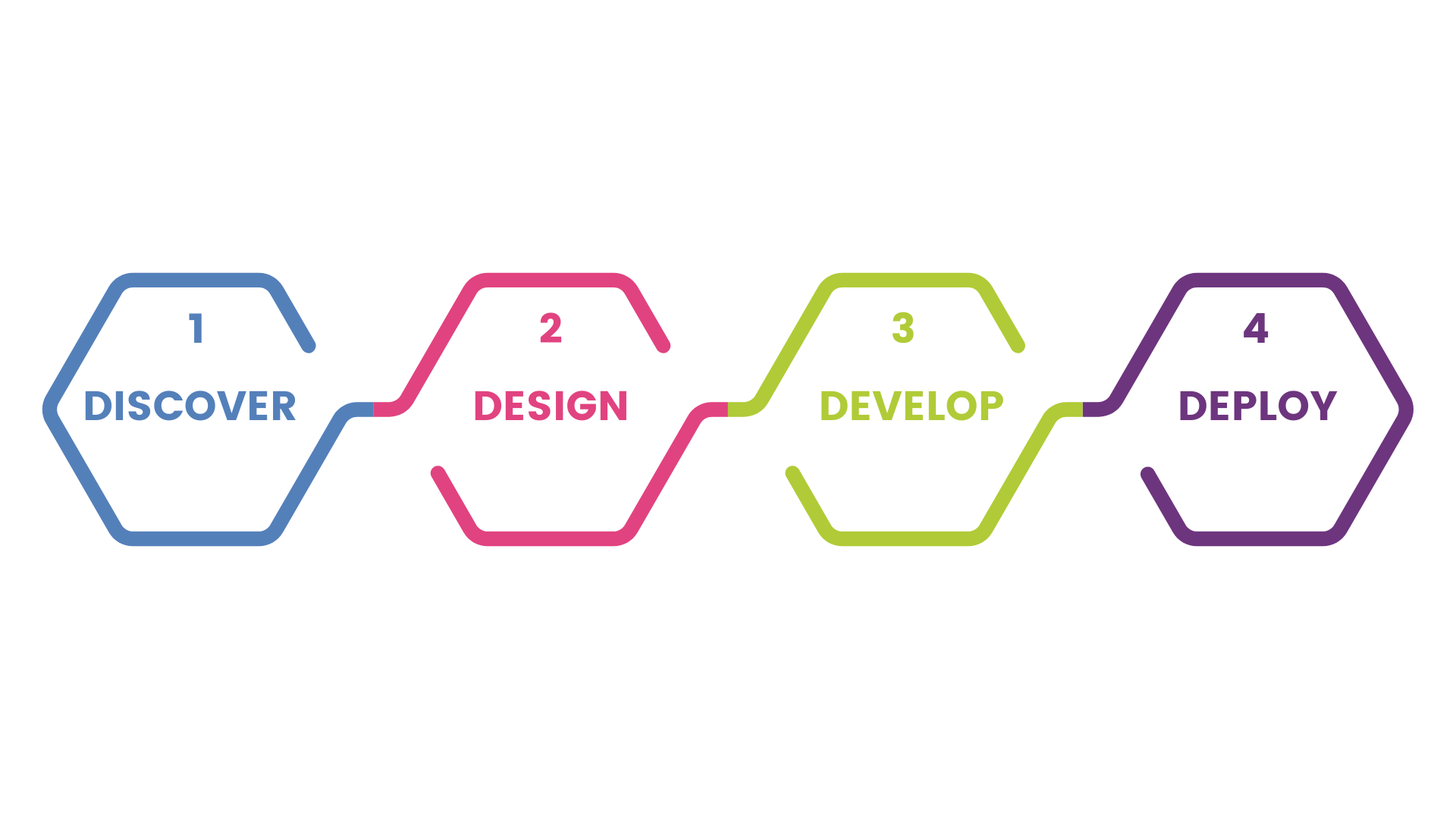
IAgents is based on a structured and pragmatic approach:
- Identify
Priority use cases, expected value, key risks
- Design
Agent journey, business rules, controls and supervision
- Deploy
Agent in production, connected to your existing system
- Operate
Continuous supervision, corrections, developments, value measurement
Deployment is not the end. Operation is the real work.
A modular offering, from launch to operation
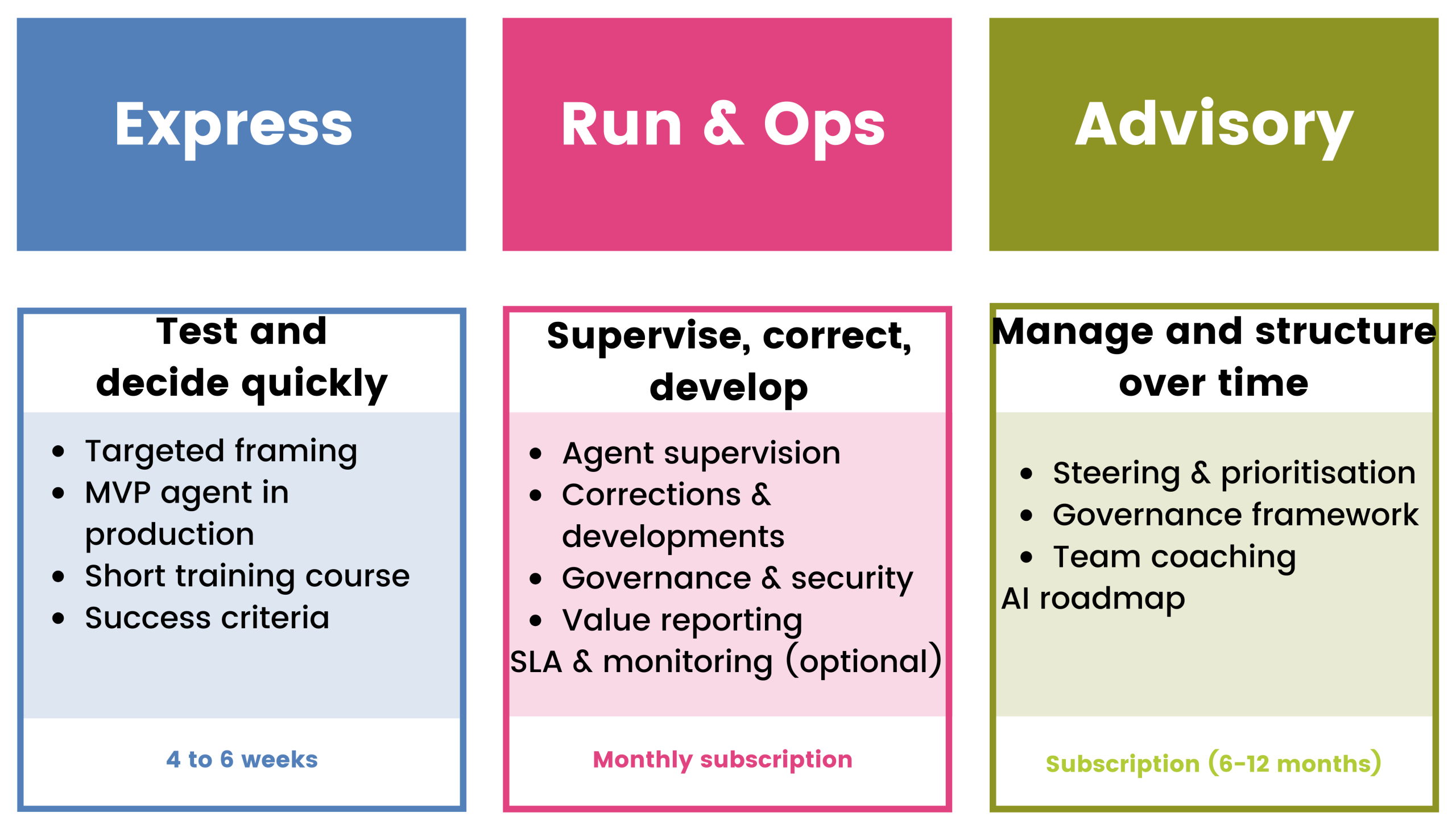
IAgents Express – Test and decide quickly (4 to 6 weeks)
- Targeted scoping
- Agent MVP in production
- Clear success criteria
IAgents Run & Ops – Monitor, correct, evolve
- Agent monitoring
- Corrections and evolutions
- Governance and security
- Value reporting
- SLA & monitoring (optional)
IAgents Advisory – Manage and structure over time
- Management and prioritisation
- Governance framework
- Team coaching
- AI roadmap
Why choose Coexya for your AI agents
- Seamless integration into existing IT systems (applications, data, processes)
- Compliance with business rules, security and compliance requirements
- Industrialisation and operating standards
- End-to-end responsibility, from integration to operation
Our value lies not in the tool itself, but in our ability to make AI agents work in real IT systems.
Get started with IAgents
Do you already have agents or AI POCs?
→ Operational diagnosis (2 weeks)
Do you have a clear business need?
→ IAgents Express (4 to 6 weeks)
FAQ – AI agents & operation
-
/ What should be done after an AI POC?
A POC validates technical feasibility, not operational capability. After a POC, risks must be framed, responsibilities defined, supervision put in place and real value measured before any industrialisation.
-
/ Why do most AI agent projects stall after the POC?
Because operational issues are often underestimated: lack of Run & Ops, unmeasured value, unmaintained agents, and unclear responsibilities.
-
/ Why does an AI agent work at first and then deteriorate?
Usage patterns evolve, data changes, and rules need to be adjusted. Without supervision and continuous improvement, quality naturally deteriorates.
-
/ Who is responsible if an AI agent makes a mistake?
Responsibility depends on the operating framework in place. In production, an agent must be operated with clear rules, traceability and validations appropriate to its criticality.
-
/ How can we avoid hallucinations from an AI agent?
We cannot eliminate them entirely. We can reduce them through a controlled perimeter, controlled sources, human validation, and continuous supervision.
-
/ Does an AI agent need to be monitored constantly?
Not manually. But its usage, costs, quality and actions must be monitored using appropriate indicators and alerts.
-
/ How can the actual value of an AI agent be measured?
Using operational indicators: usage rate, time saved, reduction in escalations, reduction in errors and costs avoided.
-
/ What is the difference between a chatbot and an AI agent?
A chatbot answers questions. An AI agent can act, trigger actions and orchestrate processes. The more it acts, the more critical its operation becomes.
-
/ When should an AI agent be shut down?
When it is no longer used, when it costs more than it brings in, or when it generates uncontrolled risks. Shutting down an agent can be a sound decision.
-
/ Is a dedicated team required to operate AI agents?
Not necessarily, but a clear framework is needed: supervision, responsibilities, operating rules and appropriate tools.