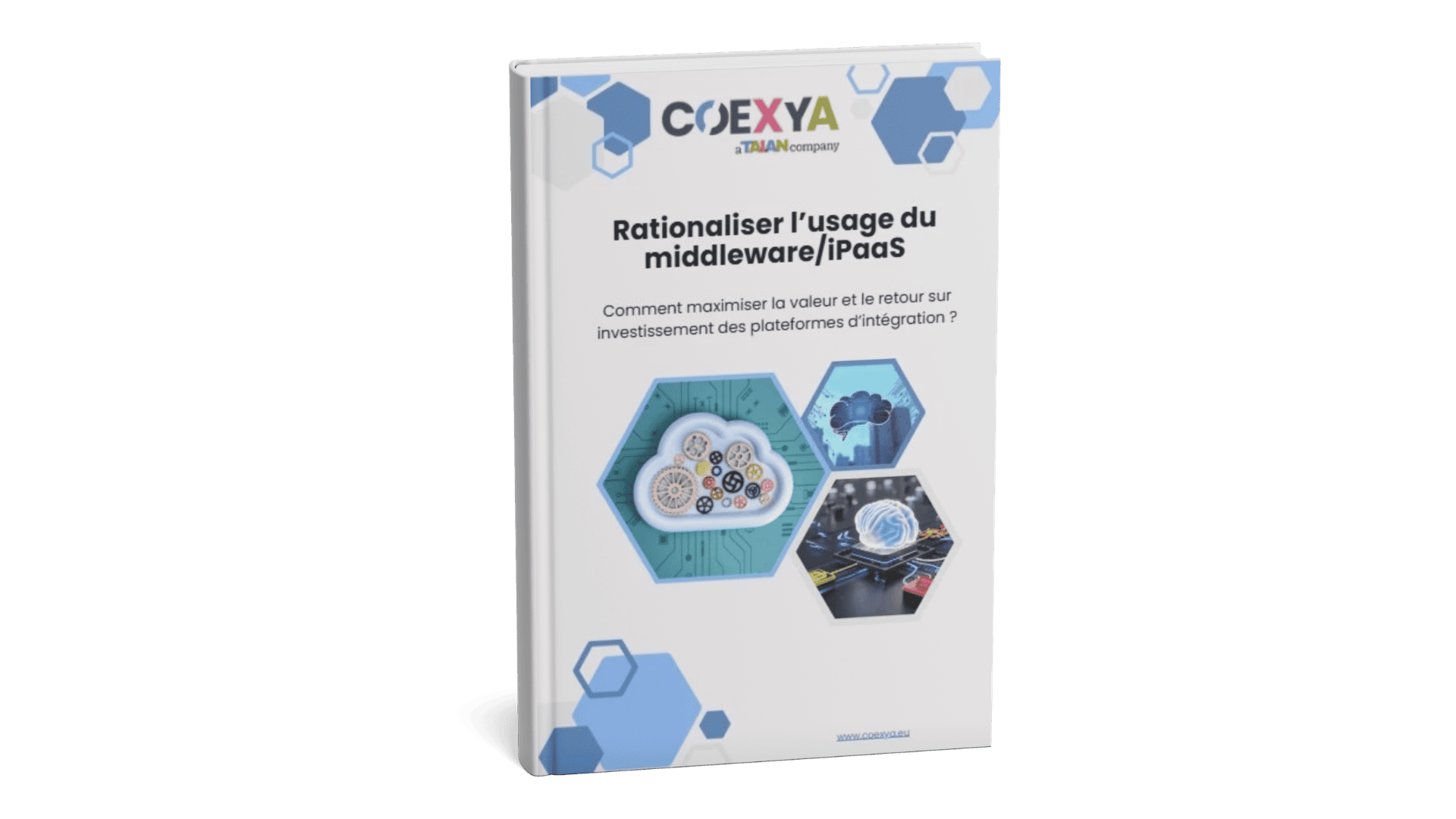
Underperforming Middleware / iPaaS: How to finally get the value you're paying For
Integration platforms are now at the heart of information systems. Yet in many organisations, they remain only partially utilised, with a return on investment that is difficult to demonstrate. How can you turn them into a true performance driver?
Many mid-sized organisations share the same frustration: their integration platform — whether middleware or iPaaS — costs a great deal relative to the actual use they make of it. Yet this is rarely a matter of having chosen the wrong tool. It is a matter of framing, governance, and prioritisation. Drawing on over 25 years of experience in complex integration projects, Coexya has formalised a pragmatic approach to help IT directors turn this around — without a full-scale overhaul of their IT landscape.
Why does your middleware/iPaaS remain underused?
The reasons are structural and widely shared across organisations. French mid-market companies manage an average of around one hundred SaaS applications, on top of legacy systems and bespoke developments — a portfolio that has doubled over the past decade. This fragmentation encourages point-to-point integrations built without any overarching vision, which in turn creates an integration debt that is difficult to unwind. Compounding the issue are the absence of a reliable map of existing data flows, insufficient governance that fuels Shadow IT, and a chronic difficulty in measuring and demonstrating the ROI of integration initiatives.
The key: rationalise before you industrialise
The classic mistake is trying to route all data flows through the middleware/iPaaS. In practice, roughly 20% of flows account for the bulk of the value. Coexya’s approach is built around three progressive steps: first, map and qualify existing flows according to their business criticality, operational risk, and technical complexity; second, rationalise by determining which flows genuinely warrant going through the integration platform; and third, industrialise practices, patterns, and governance to sustain the gains over time.
Quick wins achievable within the first few weeks
Without waiting for a full transformation programme, several actions deliver rapid and measurable benefits: consolidating the monitoring of a handful of critical flows into a single dashboard, standardising error handling with consistent message formats, migrating a few high-value flows to the middleware within a structured framework, or formalising a minimal development standard in just two to three pages.
Measuring ROI: concrete indicators to build the business case
The ROI of an integration platform cannot be measured in financial terms alone. It should be assessed across four dimensions: technical indicators (reduction in incidents, improvement in successful execution rates, fewer manual retries), functional indicators (elimination of duplicate data entry, acceleration of critical business processes), economic indicators (lower maintenance costs, reduction in bespoke developments built outside the platform), and organisational indicators (team adoption, increased autonomy, faster onboarding).
Coexya’s integration and interoperability expertise
Coexya’s Data Intelligence & Analytics Business Unit brings together over 50 specialists in interoperability, IoT, Industry 4.0, and Cloud. For more than 25 years, Coexya has supported mid-market and enterprise clients in rationalising and industrialising their integration platforms, from initial audit through to governance frameworks and the establishment of a Centre of Service.
Want to go further? Download our full white paper to discover 6 industrialisation patterns, the detailed 3-step approach, and our ROI measurement framework.
A publication written by our experts:
Mathilde Gessay, Head of the Interoperability Centre — Coexya
Cyril Cabrol, Architect — Coexya
Download the white paper in french