Open Data : help organizations to open their data on the web
Make data available to your partners, customers, users and use external data available on the web.
Why start working with open data?
The biggest feature of this technology is for Open Data needs, mainly driven by institutions, to make data available to citizens. But this technology can also be used in the corporate world internally as repositories, externally to display data for partners or harvested/consumed as third-party data


Making public data available and accessible for use on the web
In line with the W3C’s “web of data” method, we rely on the standards and tools of the semantic web to display structured data in a standardised, interoperable format that can be used automatically by machines.
Coexya proposes a proven methodology for publishing structured data on the web
We analyze the business domain and design an ontological model, reusing standardized vocabularies. We transform the data into RDF format to expose them in a public way, in the respect of best practices via warehouses providing technical query interfaces (sparq enpoint) or by making them more user friendly.
These solutions are particularly popular in the legislative (open law), cultural and health fields, and by public institutions and organizations that disseminate information to citizens.
Knowledge modeling
• Creation / use of repositories,
• Content aggregation,
• Reasoning: Inference and deduction,
• Distribution in an easily understandable / integrable format,
• SHACL validation of data.
Semantic Web
• Provision of data in standard Open Data format,
• Enrichment with external data exposed in warehouses available on the web.
Coexya is a major player in the web of public data for several years
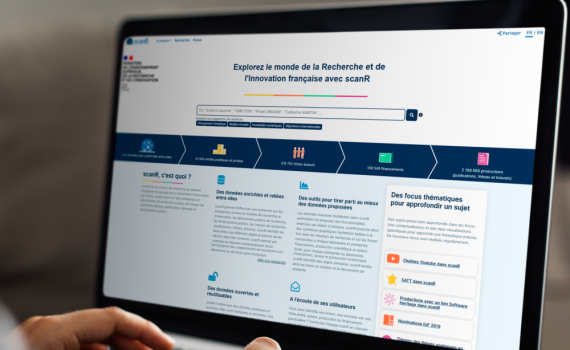
We are proud to partner with many public institutions in the implementation of their open data projects, such as the Ministry of Higher Education, Research and Innovation, the National Institute of Art History or the Digital Health Agency.

Our References




Open Data Expertise: Why choose Coexya?
- Data Release Strategy: We support public and private organisations in structuring and opening up their datasets to meet legal obligations (the Lemaire Law) and foster innovation.
- Interoperability & Data Standards: Implementation of platforms compliant with international and national standards (DCAT-AP, Schema.data.gouv.fr) to ensure maximum reuse by citizens and developers.
- Data Visualisation & Mediation: Creation of interactive dashboards and intuitive data portals to make information accessible, understandable and useful for decision-making.
FAQ: Succeeding in Open Data and Semantic Web Projects
-
/ What are the concrete benefits of Open Data for public institutions?
Open Data primarily meets transparency requirements for citizens. Beyond legal obligations, opening up data showcases public action, encourages third-party innovation, and helps create more efficient services. By structuring your data according to W3C standards, you ensure it is machine-readable, significantly increasing the impact of your publications.
-
/ Why should we use Semantic Web technologies (RDF, SPARQL)?
The Semantic Web moves beyond simple file sharing (PDF, Excel) to the sharing of structured, interconnected knowledge. By converting your data into RDF format and providing a SPARQL endpoint, you ensure maximum interoperability. Your data becomes “harvestable” and intelligible by other systems, guaranteeing high-value distribution.
-
/ How do you guarantee the quality and validation of open data?
Opening data is not enough; it must be reliable. Using validation protocols such as SHACL allows you to verify that data conforms to the defined ontological model. A rigorous knowledge modelling methodology and the use of standard repositories ensure that the published data is accurate, consistent, and immediately usable.
-
/ Can Open Data be used in the private sector?
Absolutely. For companies, Open Data can serve internally as a shared data repository or externally to expose catalogs to partners. Furthermore, consuming external public data (weather, geography, health) allows you to enrich your own analysis and decision-making tools, creating a data-driven competitive advantage.
-
/ How can I benefit from a local partner’s expertise across France (Paris, Lyon, Rennes, Lille, Brest, etc.)?
A data opening project requires a deep understanding of your business and regulatory challenges. Our expert consultants support you from our offices in Paris, Lyon, Rennes, Lille, and Brest. This multi-city presence allows us to hold modelling and design workshops directly at your premises, ensuring agile support and optimal responsiveness throughout your digitisation project.
